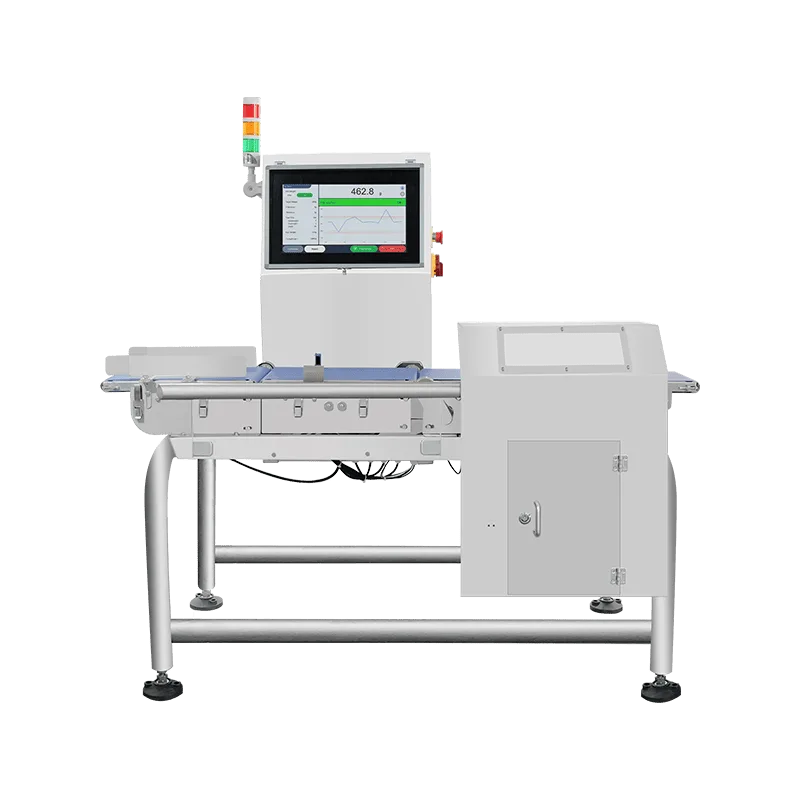
Automated food packaging requires more than fast filling and sealing. Each final pack must also fit its weight range. Manual sampling can find issues, but it cannot check every pack in a continuous production process. A checkweigher is an in-line control point that dynamically weighs packed items and separates those beyond weight restrictions.
Food makers value direct weighing-packaging flow integration. The technology monitors individual packets without stopping the conveyor or removing items for manual inspections. Easyweigh creates dynamic weighing and inspection equipment for food manufacturing, especially packaged food.
Where Weight Control Fits Into Automated Packaging
The most logical position for automated weight verification is after the product has been filled into its package and sealed. At that stage, the package represents the finished unit that will leave the production line, making its actual weight directly relevant to quality control and quantity consistency.
A conveyor carries each pack toward the weighing section. Instead of stopping every package on a static scale, the system measures products while they continue moving. That dynamic operation makes weight verification compatible with continuous packaging processes.
The need becomes especially clear when filling equipment operates at high output. Small variations in product quantity can accumulate across many packs. A weighing station placed directly in the line can identify individual deviations instead of relying only on periodic samples.
How a Checkweigher Makes the Weight Decision
The weighing sequence is straightforward but depends on stable product movement. A package enters the weighing section, passes across the weighing conveyor, and receives a weight measurement. Software then compares that result with the configured acceptable range.
Products within the target range continue through the line. Packs outside the permitted limits can be identified for removal. Easyweigh describes its checkweighing systems as automated weighing equipment that measures products in real time and rejects underweight or overweight items.
Weight verification therefore becomes an automated decision rather than a separate inspection task. The operator does not need to manually weigh each package, record the result, and return acceptable units to the production flow.
Different packaged products can also require different weighing configurations. Product dimensions, weight range, conveyor conditions, and production speed all influence the appropriate system design. Easyweigh offers general-purpose, high-speed, and heavy-weight configurations for different product requirements.
Handling Underweight and Overweight Packs Without Manual Checks
The purpose of automated weighing is not simply to display a number. The system must act on that measurement when a package does not meet its defined specification.
A suitable rejection mechanism can remove the nonconforming pack while allowing accepted products to continue downstream. Depending on the application, available mechanisms can include pushers, air jets, or diverters. The choice depends on package characteristics and the required production arrangement.
This closed-loop sequence is particularly useful for food packaging because it reduces dependence on manual intervention. An operator can focus on line supervision while the equipment performs repetitive weight verification.
Weight control can also help reduce unnecessary product giveaway. If filling equipment consistently adds more product than required, the resulting excess may increase material costs. Detecting the actual weight of individual finished packs gives production teams a clearer basis for identifying such variation.
Connecting Weight Verification With the Rest of the Line
A packaging line rarely consists of one machine operating independently. Filling, sealing, conveying, weighing, metal detection, X-ray inspection, and other stages may need to work together. The weighing station therefore needs to fit the movement and control logic of the wider line.
An in-line checkweigher can be positioned within the conveyor path so that products reach the weighing section automatically. Integration capability should be evaluated against the existing conveyor arrangement, product dimensions, operating speed, and downstream inspection requirements.
Weight inspection can also form part of a broader quality-control system. Easyweigh states that its checkweighers can integrate with metal detectors and X-ray systems, allowing different inspection functions to operate within a connected production environment.
Such integration avoids treating weight verification as an isolated final check. Instead, it becomes one stage in a coordinated inspection workflow covering both product quantity and other quality or safety requirements.
Matching the System to the Packaging Operation
Selecting equipment for an automated packaging line starts with the product rather than the machine name. The packaged product’s weight and dimensions determine the weighing range and conveyor requirements. Lightweight sachets, prepared meals, and heavy cartons can demand substantially different configurations.
Production speed is another defining factor. A high-volume line needs equipment capable of processing products at the required rate without disrupting upstream or downstream operations. Accuracy also needs to match the actual control objective rather than being selected independently of the product and process.
The rejection method deserves equal attention. Fragile packages may require gentler handling, while robust products may tolerate a different mechanism. Space around the conveyor, package spacing, and the destination of rejected products can all influence the final configuration.
Easyweigh lists different accuracy and operating ranges across its checkweigher solutions, including general-purpose systems and equipment for heavier packages. These differences illustrate why automated weighing should be matched to the specific packaging workflow rather than treated as a one-size-fits-all purchase.
Turning Final-Pack Weight Into Process Control
A checkweigher gives an automated food packaging line a direct method for verifying every passing pack against a defined weight range. More importantly, the measurement can trigger an immediate decision, keeping nonconforming products from continuing through the normal product flow.
For manufacturers, this creates a practical link between packaging output and quality control. Weight deviations become detectable at the point where finished packages are moving through production, while accepted products can continue automatically.
Easyweigh positions its dynamic checkweighing systems around accurate weighing, production efficiency, product consistency, and integration with other inspection equipment. For automated food packaging, that combination turns weight verification from a periodic manual task into a continuous production-line control point.
