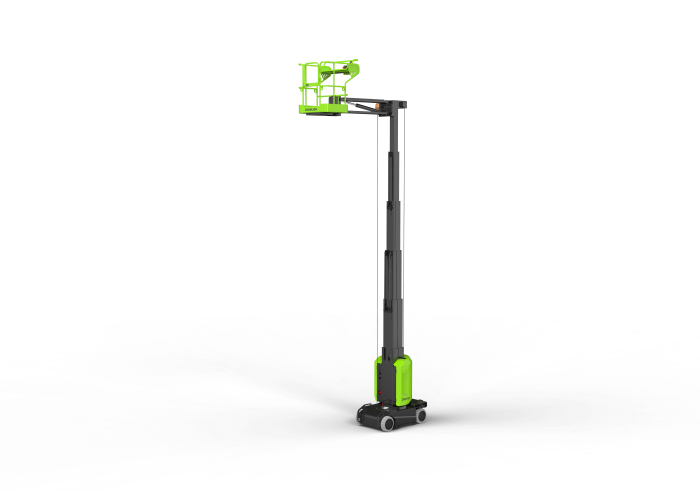
A vertical mast lift is designed for service work where technicians need repeatable access to elevated points without bringing a large machine into the work area. Routine calls can involve lighting, electrical systems, HVAC components, signage, interior finishes, or facility maintenance. For these jobs, deployment efficiency depends on more than lifting height. Machine footprint, maneuverability, power, controls, and preparation time all influence how practical the equipment is.
Compact Dimensions Simplify Site Access
Routine service calls often happen in occupied buildings rather than open construction zones. Retail facilities, warehouses, airports, offices, and industrial interiors can contain narrow aisles, finished floors, doorways, fixed equipment, and pedestrian traffic. A machine that occupies less space can make positioning easier while reducing interference with normal site operations.
An electric vertical mast lift can be particularly practical for indoor work because battery-powered operation avoids the exhaust associated with combustion engines. However, users still need to consider the manufacturer’s operating instructions, floor conditions, permitted slope, platform capacity, and local requirements before deployment. Equipment selection should reflect the actual access task rather than height alone.
Maneuverability Reduces Repositioning Time
Service technicians may need to visit several access points during one shift. Excessive turning and repositioning can make a compact job unnecessarily disruptive. A tight turning radius, manageable machine width, and responsive controls can help operators place the platform accurately around fixed obstacles and within restricted work areas.
Mobility also depends on travel conditions. IPAF recommends that MEWPs receive appropriate pre-use checks and that users follow manufacturer instructions. Their guidance identifies pre-use inspections, scheduled servicing, and periodic inspections as interconnected parts of keeping equipment in safe working condition.
Battery Power Supports Repeated Indoor Work
For routine maintenance, an electric vertical mast lift removes the need to bring fuel-powered equipment into areas where exhaust management would be a concern. Battery operation can also simplify daily preparation because operators can focus on charge status, controls, tires, structure, and other required inspection points before starting work.
Battery capacity should still be evaluated against the expected number of access cycles and working hours. Charging arrangements, duty cycle, ambient conditions, and service requirements can affect availability. IPAF’s current inspection guidance states that pre-use checks should follow the manufacturer’s manual, reinforcing the need to combine equipment specifications with the actual maintenance plan.
Platform Capacity Matters During Service Calls
Routine service work may appear lightweight, but technicians still carry tools, replacement components, testing devices, and personal protective equipment. The total load must remain within the machine’s rated platform capacity. Teams should also determine whether the intended number of occupants and operating environment match the equipment’s permitted configuration.
This is especially important when service tasks become more complex. A machine that is easy to deploy but frequently reaches its load limit may slow the job or require additional trips. Procurement teams should therefore consider platform capacity alongside access height, dimensions, travel speed, and the characteristics of the facilities where the machine will be used.
Pre-Use Checks Keep Deployment Predictable
Easy deployment does not remove the need for inspection. IPAF states that a MEWP should be inspected daily or at the beginning of each shift to confirm that it is safe to use and will not cause injury to occupants or other personnel. The checks should be completed according to the manufacturer’s requirements and appropriate workplace procedures.
For service fleets, consistent inspection routines can also make equipment availability easier to manage. Operators can identify visible damage, control problems, tire issues, leaks, or other abnormalities before the machine reaches the work area. Any issue that affects safe operation should be addressed before the equipment returns to service.
How Zoomlion Access Addresses Routine Access Needs
For buyers comparing a vertical mast lift, the ZMP09J from Zoomlion Access provides a specification-based example. The manufacturer lists a platform height of 11.2 m and a platform capacity of 200 kg. The machine is specified for a maximum of two workers indoors and one worker outdoors, giving fleet planners clear parameters when matching it with routine service requirements.
The ZMP09J has an overall height of 1.99 m, overall length of 0.76 m, and overall width of 0.99 m. Its listed inner turning radius is 0.20 m, while the outer turning radius is 1.61 m. The machine also has a 25% gradeability rating, a maximum working slope of 2.5°, rear-wheel drive, and solid seamless tires.
Why the ZMP09J Fits Repeat Service Operations
The ZMP09J uses AC electric drive and lifting motors, with a 4×6V/240Ah battery and 24V/30A charger. Zoomlion Access lists a drive speed of 4.5 km/h when stowed and 0.5 km/h when raised, while its specified lifting and lowering times are 42 and 40 seconds. These details help service managers estimate movement and access cycles when planning repeated tasks.
The ZMP09J weighs 2,990 kg and includes proportional control. Its specification sheet also lists a 1 m platform extension, providing additional positioning capability for suitable tasks within the manufacturer’s operating limits. For companies managing recurring facility maintenance, these measurable characteristics can support more consistent equipment selection across similar jobs.
Choosing Equipment for Routine Service Calls
A practical electric vertical mast lift should make access easier without creating unnecessary transport, positioning, or preparation work. Buyers should compare dimensions, turning performance, platform capacity, battery system, operating limitations, inspection requirements, and the physical conditions of their service locations before selecting equipment.
Zoomlion Access currently lists five vertical mast lift models, including the ZMP04, ZMP06, ZMP06G, ZMP08J, and ZMP09J, alongside broader MEWP categories such as scissor lifts, articulating boom lifts, telescopic boom lifts, spider lifts, and telehandlers.
For recurring maintenance work, a vertical mast lift such as the ZMP09J can be assessed against the actual access route, working height, load, floor environment, and frequency of service calls. Reviewing those factors before procurement helps teams choose a machine that is practical for repeated deployment while keeping equipment operation aligned with manufacturer specifications and established inspection practices.
