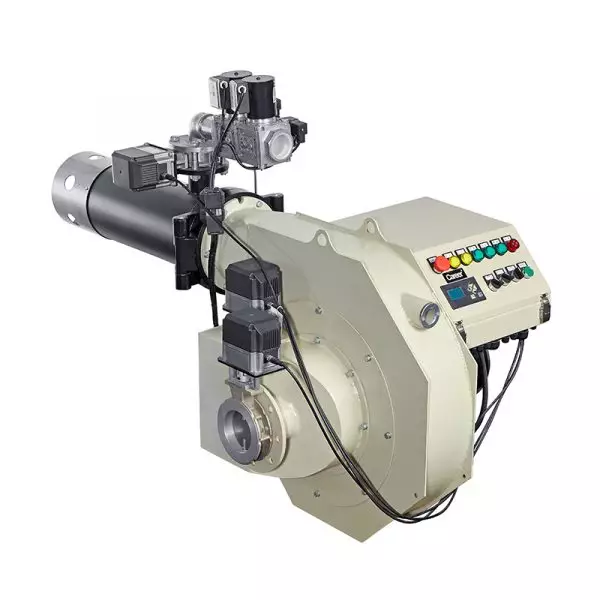
Industrial gas burners can reduce fuel consumption when combustion delivers the required heat with less wasted energy. Efficient fuel use comes from controlling fuel-air mixing, keeping combustion stable, matching heat input to process demand, and limiting losses caused by excessive air or poor load control.
A properly engineered burner can make combustion more controllable, helping the thermal system obtain required process heat without routinely firing more fuel than necessary.
Start by Controlling How Fuel and Air Burn
Combustion needs both fuel and oxygen, but the quantity and distribution of combustion air matter. Too little air can interfere with complete combustion, while too much air can increase the amount of heated gas leaving through the exhaust. Both situations can reduce useful energy recovered from fuel.
A low NOx gas burner can incorporate combustion-control technologies that manage fuel-air mixing while also targeting lower nitrogen oxide formation. Career Burner describes its low-NOx burners as using technologies such as flue gas recirculation, staged combustion, lean premixing, and air-to-fuel ratio control. These methods change combustion conditions so the burner can maintain controlled operation while addressing emissions.
Air-to-fuel ratio control is particularly relevant to fuel consumption because the mixture can be regulated as operating conditions change. Instead of relying on a fixed relationship between gas and air, the combustion system can respond to changes in firing demand and maintain conditions required by the process.
Reduce Energy Lost Through Excess Air
A burner may consume more gas than necessary if the thermal system operates with poorly controlled combustion air. Excess air enters the combustion chamber, becomes heated, and can ultimately leave through the exhaust. That represents energy supplied by the fuel but not converted into useful process heat.
Improving combustion control does not mean eliminating excess air entirely. Industrial equipment requires appropriate combustion conditions, and the correct operating point depends on burner design, furnace configuration, fuel, and process requirements.
Career Burner lists an air-to-fuel ratio controller among the technologies used with low NOx gas burner solutions. Such control can be valuable where firing conditions vary because maintaining an appropriate mixture across the operating range can reduce avoidable combustion losses.
Match Gas Input to Actual Heat Demand
Fuel consumption also rises when burner output does not correspond well with the actual thermal load. A furnace, boiler, dryer, or other process heater may operate below maximum capacity for substantial periods. If the burner cannot respond effectively, the system may rely on unnecessary firing, frequent cycling, or inefficient operating points.
An ultra low NOx burner is designed primarily around very low NOx emissions, but selection still needs to consider load behavior and control requirements. Career Burner states that its burners can be tailored for high-turndown, staged-combustion, and variable-load applications.
Turndown becomes useful when required heat release changes substantially. Instead of treating maximum capacity as the normal operating condition, an appropriately configured burner can provide a closer match between fuel input and actual process demand.
Keep Low-NOx Combustion Aligned With Thermal Duty
Reducing NOx and reducing fuel consumption are related to combustion control, but one does not automatically guarantee the other. A burner should not be selected solely because it has a low emissions rating. Its combustion method must also suit the equipment receiving the heat.
The product range uses flue gas recirculation technology and is designed for boilers, incinerators, and food-processing equipment. It is listed as compatible with natural gas, LPG, and biogas.
Flue gas recirculation can lower flame temperature by returning part of the exhaust stream to the combustion process, while staged combustion and lean premixing alter the conditions in which fuel is burned.
Select the Burner Around the Operating Profile
The most direct route to fuel savings is selecting a burner according to actual thermal duty rather than maximum rated capacity alone. Engineers should examine required heat input, fuel type, combustion-air conditions, available gas pressure, furnace geometry, control method, operating range, and expected load changes.
Capacity information illustrates why this matters. The referenced product category lists a 700–3300 kW capacity range. A burner should be sized and configured around the equipment’s real operating requirements rather than simply choosing the highest available output.
Existing installations can reveal opportunities for improvement. Fuel flow, exhaust temperature, combustion-air settings, burner cycling, and process temperature trends can show whether energy is being lost through poor control or mismatched firing.
What Actually Makes the Fuel Saving Possible?
The fuel-saving mechanism is better control of the energy conversion process. The burner receives gas and air, creates a controlled flame, and transfers heat into the process. Every unnecessary unit of fuel-air flow, unstable condition, or poorly matched firing point can reduce the proportion of fuel energy that becomes useful heat.
An ultra low NOx burner may therefore contribute to efficient operation when its combustion technology, controls, turndown capability, and thermal characteristics are correctly matched to the application. Its value should be assessed as part of the complete combustion system, not as an isolated component.
Industrial gas burners reduce fuel consumption primarily through better combustion control and closer matching between fuel input and process heat demand. Excess-air management, appropriate turndown, stable flame operation, and suitable burner configuration all affect how much gas becomes useful thermal energy. The right burner is not simply the one with the lowest rated fuel input; it is the one engineered to deliver the required heat efficiently across the plant’s real operating range.
