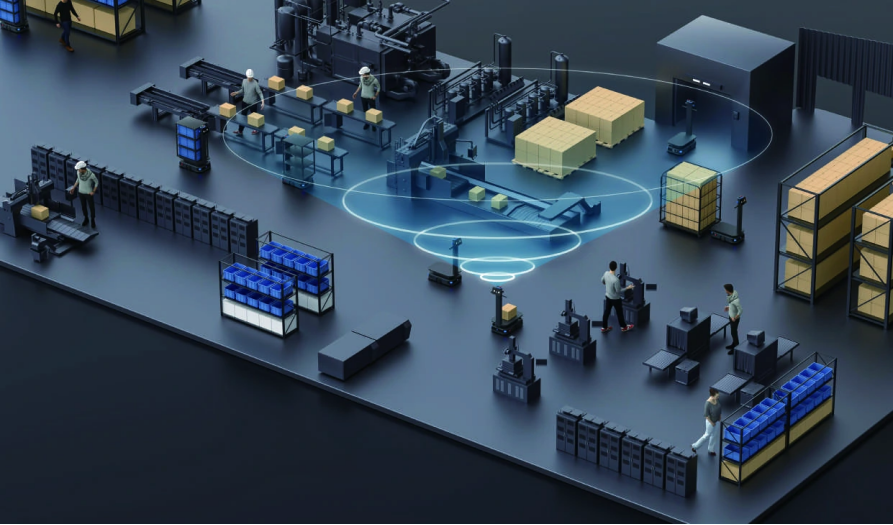
Autonomous mobile robots now sit in the middle of a bigger operational choice: which internal transport loops should be handled by people, fixed automation, forklifts, conveyors, AGVs, AMRs, or some mix of all of them.
June 3, 2026 | 14 min read
A warehouse team rarely gets in trouble because a robot cannot drive across a clean demo area. Trouble starts later, when a route crosses forklift traffic, a cart is heavier than expected, a doorway is tight, the WMS task does not sync, or night-shift operators do not know who owns exceptions.
That is why industrial AMR selection in 2026 should start with the workflow, not the robot. A good robot demo proves movement. A good AMR business case proves that a repetitive transport loop can run safely, predictably, and with fewer interruptions to the people already doing the work.
Short answer: manufacturers and warehouses should choose an industrial AMR by mapping three to five repetitive transport workflows first. For each workflow, define the load, route, floor conditions, traffic, software handoff, safety requirements, uptime target, and service model. Then choose robots whose payload, passability, navigation, interoperability, and support model fit those workflows.
Why AMR selection is harder in 2026
The category is no longer experimental. The International Federation of Robotics reported that professional service robot sales reached almost 200,000 units in 2024, with transportation and logistics accounting for 102,900 units in its supplier sample. The same IFR release describes indoor goods transport as the most important application within that segment.
At the same time, supply chain leaders are putting more money into technology. Coverage of the 2026 MHI Annual Industry Report says 56% of supply chain leaders are increasing technology and innovation investment, and that those investments include AI and robotics for resiliency, visibility, transparency, and workforce pressure.
AMRs are easier to find, finance, and pilot than they were a few years ago. That does not make them easier to choose. More vendors, more deployment models, and more software layers mean teams must define fit more carefully.
Gartner’s 2026 warehouse prediction also points in this direction. Gartner expects half of new warehouses in developed markets to be designed as robot-centric facilities by 2030, and it notes that the market for intralogistics smart robotics is fragmented and will need multiagent orchestration for mixed robot fleets. That is not a reason to buy the most complex system first. It is a reason to avoid a robot that works only as a one-off island.
Start with the work, then the robot
The first selection question is not “Which AMR is best?” It is “Which transport work should become more repeatable?”
In a factory, the answer may be line-side material replenishment, work-in-process transfer, quality sample delivery, or finished-goods movement. In a warehouse, it may be assisted picking, returns movement, staging replenishment, tote transfer, or rack movement. Each job asks something different from the robot.
| Workflow | Typical operating pattern | What the AMR must prove |
| Line-side delivery | Fixed or semi-fixed routes between storage and production cells | Timed delivery, narrow-aisle navigation, safe mixed traffic, easy route updates |
| Kitting and component delivery | Frequent small-load movement from supermarket areas to stations | Load stability, container fit, task confirmation, simple operator calls |
| Work-in-process transfer | Movement between production steps or inspection points | Docking accuracy, traceability, exception handling, MES handoff |
| Warehouse assisted picking | Robot follows or receives tasks across aisles | Picking ergonomics, WMS task flow, aisle passability, battery coverage |
| Finished-goods or 3PL transfer | Higher-volume movement to staging, packing, or dispatch | Fleet coordination, charging plan, throughput under peak load |
| Heavy rack or pallet support | Large loads, underride platforms, towing, or rack movement | Payload margin, floor quality, traffic control, service readiness |
Table 1 – Workflow-to-requirement matrix.
This workflow-first method sounds plain, but it prevents a common mistake: buying for the edge case. A team sees one heavy load or one complex route and designs the entire project around it. The better approach is to separate high-frequency daily loops from occasional exceptions. If 80% of the transport work involves 80 kg bins and a few routes involve 500 kg racks, one robot class may not be the right answer.
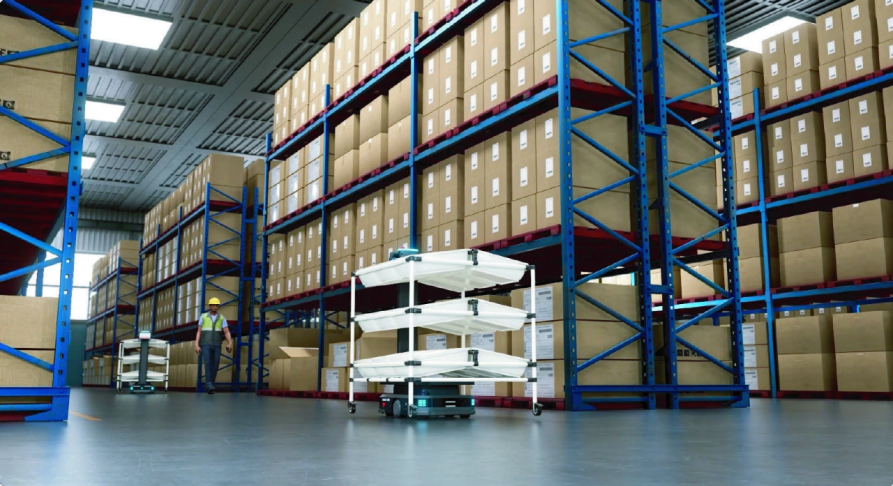
Figure 1 – Warehouse picking and internal transport workflows should be mapped before buyers compare payload claims or fleet software.
Decide whether AMR is the right automation type
AMRs are strong when the facility needs flexible routing in a changing indoor environment. They are less attractive when the process is extremely fixed, very high throughput, or better served by mechanical automation.
| Option | Best fit | Watch-outs |
| Manual carts or pallet jacks | Low volume, short routes, fast process changes | Hard to scale, inconsistent timing, ergonomic load on staff |
| Forklifts | Heavy loads, vertical lift, pallet movement, mixed outdoor/indoor work | EHS exposure, driver availability, traffic risk, limited traceability |
| Conveyor | High-volume fixed flow between stable points | Layout changes are expensive; poor fit for variable routing |
| AGV | Predictable routes with controlled traffic and stable layouts | Lower flexibility if route changes require markers, magnets, or infrastructure work |
| AMR | Dynamic indoor routes, mixed workflows, staged rollout, changing layouts | Needs good workflow design, safety validation, integration, and fleet governance |
| AS/RS or goods-to-person systems | Dense storage and high-throughput picking | Higher facility design effort and capital planning |
Table 2 – AMR versus other material handling options.
For many manufacturers, AMRs are most useful in the gap between manual movement and fixed automation. They can support repetitive internal transport without rebuilding the plant around one fixed path. For many warehouses, AMRs make sense when walking time, tote movement, or staging flow consumes too much supervisor attention during normal shifts and peak periods.
The wrong use case is just as important. If a facility needs vertical pallet handling, a standard AMR may not be enough. If routes never change and volume is constant, conveyor or AGV infrastructure may be more economical. If the site has rough floors, outdoor yards, freezer conditions, or strict hygiene needs, the standard indoor AMR category may require specialized engineering.
Use seven criteria to build the shortlist
Once the workflow is clear, selection becomes less abstract. These seven criteria should shape the first shortlist and the later pilot.
1. Payload, load shape, and margin
Payload is more than weight. Buyers should record the actual cart, tote, rack, or shelf that the robot will move, including center of gravity, load height, fastening method, and the worst normal load. A robot rated for 300 kg may still be the wrong robot if the load is awkward, top-heavy, unstable, or hard to dock.
Do not buy to the average load. Buy to the real operating load with margin. If the route involves 120 kg most of the day and 180 kg several times per shift, the 180 kg job drives the selection.
2. Passability and floor conditions
Passability is where many clean demos break. Measure aisle width, door width, intersection width, turning space, ramps, thresholds, grooves, elevator entries, floor markings, wet areas, and temporary obstacles. Small differences matter when robots, carts, operators, and forklifts share a route.
The site survey should include normal disruption, not just the ideal path. If pallet wrap, temporary bins, parked carts, or cleaning equipment often appear in the aisle, the vendor needs to show how the robot detects, avoids, reroutes, waits, or escalates.
3. Navigation and perception
Navigation claims sound similar across vendors, but the site matters. LiDAR SLAM, visual SLAM, QR codes, reflectors, markers, and hybrid methods can all work when matched to the environment. The question is whether the robot can stay localized in the buyer’s real building: high ceilings, long corridors, repeated rack patterns, glass, low obstacles, lighting changes, and people moving nearby.
Ask vendors to explain map updating, recovery after localization loss, obstacle behavior, and how route changes are made. The person who updates routes after a line change is often not the same person who attended the vendor demo.
4. Safety and EHS fit
OSHA’s warehousing overview lists hazards tied to powered industrial trucks, ergonomics, material handling, slip/trip/falls, and robotics. AMRs should be evaluated as part of that EHS system, not as a separate novelty.
For safety standards, buyers should know two references. ISO 3691-4:2023 covers safety requirements and verification for driverless industrial trucks and includes autonomous mobile robots among its examples. ANSI/RIA R15.08-1-2020 specifies safety requirements for industrial mobile robots and the hazards associated with them.
A compliant robot is only part of the answer. The operating zone, traffic rules, emergency stops, signage, speed settings, pedestrian crossings, forklift interactions, maintenance procedures, and staff training still need site-level validation.
5. Software integration and task ownership
An AMR that moves well but receives work badly will frustrate the floor. Buyers should define where tasks originate: WMS, MES, ERP, PLC, call button, pager, mobile app, on-device touch screen, API, or supervisor dispatch.
Also define ownership. Who creates the task? Who cancels it? Who resolves a blocked route? Who handles failed docking? Who restarts a robot after a safety stop? In mature deployments, exception ownership is as important as route planning.
6. Fleet management and interoperability
One robot can be managed locally. A fleet needs rules. When multiple AMRs, AGVs, forklifts, cleaning robots, elevators, gates, and workstations share a facility, buyers need to ask how traffic will be coordinated.
The 2026 release of VDA 5050 version 3.0 is worth watching because it expands the communication interface for mobile robots, including robots with higher autonomy and zone concepts for free navigation. The MassRobotics AMR Interoperability Standard is another useful reference: it focuses on sharing basic information such as capability, location, and robot status across vendors, while not requiring vendors to share proprietary maps.
The buyer question is simple: what information can the robot share, what can the central system control, and what remains vendor-specific?
7. Uptime, charging, and service model
A robot that handles a route for two hours is different from one that supports a two-shift or three-shift operation. Buyers should model run time under load, charging time, battery swap process, docking reliability, spare parts availability, remote support, local service coverage, and maintenance ownership.
Uptime planning should be specific. If one robot is charging, does another cover the route? If the robot is blocked, does the task reassign? If a battery degrades, who notices before the route fails?
Build a vendor scorecard before the demo
Vendor demos are useful after the buyer has written the evaluation rules. A scorecard keeps the conversation grounded.
| Criterion | What to ask | Evidence to request |
| Workflow fit | Which of our routes can your robot run without facility changes? | Site-survey notes, route simulation, deployment plan |
| Payload fit | What load shape and margin are supported? | Product spec, cart/rack drawings, docking test |
| Safety fit | Which standards apply and what must be validated on site? | ISO/ANSI documentation, risk assessment method |
| Integration | How do tasks move between WMS/MES and robot fleet? | API docs, integration examples, fallback process |
| Fleet governance | How are traffic, priorities, blocked paths, and charging handled? | Fleet manager demo, exception logs, control logic |
| Service model | Who supports hardware, software, batteries, and training? | SLA, spare parts plan, local support structure |
| Scale plan | How does the pilot become a multi-route deployment? | Rollout roadmap, multi-site references, governance model |
Table 3 – Industrial AMR vendor scorecard.
Use the scorecard twice: first to shortlist vendors, then to judge the pilot. That keeps the project from drifting toward whatever looked most impressive in the showroom.
Read product specs as workflow clues: the Pudu Robotics example
Pudu Robotics is a useful example because its industrial delivery line spans different payload classes. The product pages for PUDU T150, PUDU T300, and PUDU T600 show how buyers can read specs as workflow clues rather than isolated numbers.
| Product | Payload class | Stronger fit to examine | Selected official specs |
| PUDU T150 | 150 kg | Light-load, high-frequency transport, component delivery, warehouse picking support | VSLAM + LiDAR SLAM, 60 cm passable width, 12 h no-load operating time, 20 mm step, 35 mm gap |
| PUDU T300 | 300 kg | Medium-load factory logistics, shelf mode, lifting mode, towing mode, line-side delivery | 300 kg maximum load, 60 cm path clearance, VSLAM and LiDAR SLAM, 12 h no-load and 6 h full-load runtime |
| PUDU T600 | 600 kg | Heavy rack or large-payload movement, standardized fleet deployment, on-premises control | 600 kg maximum load, VDA 5050 support, 12 h no-load runtime, standard and underride configurations |
Table 4 – PUDU T series payload and use-case mapping.
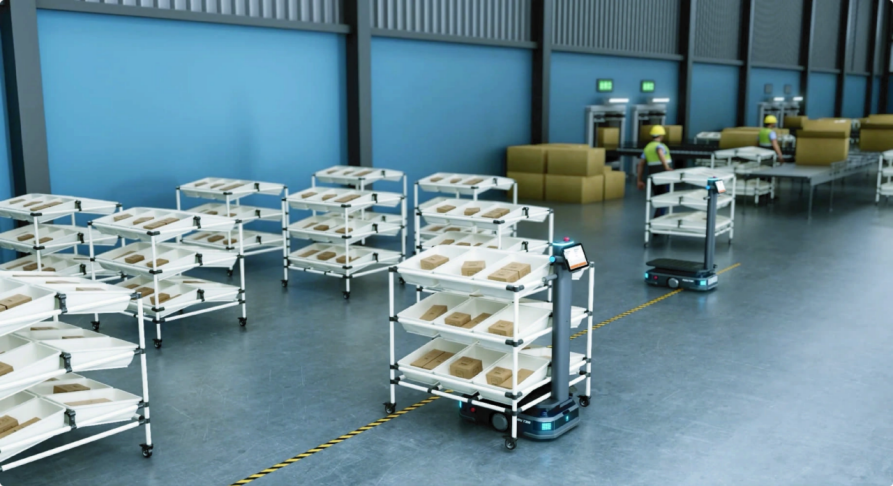
Figure 2 – A medium-payload AMR class is often evaluated for cart, tote, or rack movement between warehouse zones and staging areas.
The procurement lesson is not that one payload number is better than another. It is that payload classes should map to workflow groups. A light-load AMR may be the most practical tool for small-item replenishment. A medium-load AMR may cover line-side delivery, shelf movement, and inter-zone transfer. A heavy-payload or underride AMR may be needed when racks, larger carts, or heavier loads drive the route design.
Pudu Robotics also publishes broader company context: its company page states that it has shipped over 120,000 units globally and operates in more than 80 countries and regions. For procurement teams, that kind of deployment base supports confidence in product maturity, service learning, and multi-market support when industrial AMRs move from pilot to scale.
Design the pilot to prove operations, not curiosity
A pilot should test a repeatable route under real operating conditions. It should not be a general robotics demo.
Good pilot design starts with one to three routes that matter enough to measure but are bounded enough to control. Include the real load, handoff, shift traffic, charging behavior, exception handling, and software task flow.
| Pilot item | What to define before launch |
| Route | Start point, end point, stops, crossings, restricted zones, and expected daily trips |
| Load | Weight, dimensions, cart/rack design, center of gravity, and securing method |
| People | Operators, supervisors, EHS owner, maintenance owner, IT/OT owner |
| Software | Task source, confirmation method, exception logic, reporting fields |
| Safety | Speed zones, crossings, emergency stops, signage, training, risk assessment |
| Measurement | Completion rate, intervention rate, blocked-route events, task accuracy, downtime |
| Scale trigger | Clear rule for adding routes, robots, shifts, or sites |
Table 5 – Pilot definition checklist.
The pilot should end with a decision. If the route works, define what scales next. If it fails, identify whether the issue is workflow design, facility condition, integration, service, or robot capability.
Questions to put in the RFP
Buyers do not need a 90-question RFP to learn whether a vendor understands industrial operations. They need questions that expose ownership, proof, and tradeoffs.
1. Which of our mapped workflows fit your current product without custom engineering?
2. What payload, floor, aisle, lighting, and traffic assumptions are required?
3. Which safety standards does the robot support, and which safety tasks remain site-specific?
4. How are maps created, updated, validated, and recovered after layout changes?
5. What information can your fleet manager share with WMS, MES, ERP, elevators, gates, and third-party systems?
6. Does your system support VDA 5050, MassRobotics interoperability, open APIs, or another fleet interface?
7. How are blocked routes, failed docks, missed calls, charging conflicts, and emergency stops logged?
8. What service coverage, spare parts, training, and escalation path are available in the deployment region?
9. What pilot evidence will prove that this project should scale?
10. What operational changes must the buyer make before the robot can succeed?
The last question matters. Good vendors can explain what the robot will not fix by itself, especially where layout discipline, barcode quality, traffic rules, or task data need cleanup first.
FAQ
What is the most important criterion when choosing an industrial AMR?
Workflow fit is the most important criterion. Payload, navigation, battery life, and integration all matter, but they only make sense after the buyer defines the route, load, traffic, software handoff, and success metric.
How is an AMR different from an AGV?
An AGV usually follows a more fixed path or guided infrastructure. An AMR is designed for more flexible navigation in dynamic indoor environments. The boundary can blur because modern systems vary, so buyers should compare the actual navigation method, route-change process, facility modification requirement, and fleet control model.
What payload class should a warehouse or factory choose?
Choose payload by workflow group. Light-load AMRs may fit small-item replenishment and picking support. Medium-load AMRs may fit carts, shelves, and line-side delivery. Heavy-payload AMRs may be needed for racks, larger carts, or pallet-adjacent workflows. Always check load shape and margin, not weight alone.
Which safety standards matter for industrial AMRs?
ISO 3691-4 and ANSI/RIA R15.08 are the two main references many buyers should know. ISO 3691-4 covers driverless industrial trucks and includes AMRs as examples. ANSI/RIA R15.08 addresses industrial mobile robot safety requirements. Buyers also need site-level EHS validation, training, traffic rules, and operating-zone preparation.
Is interoperability required for an AMR project?
Interoperability becomes more important as the fleet grows or as multiple robot types share a facility. A single-route pilot may not need full mixed-fleet orchestration. A multi-site program should ask early about VDA 5050, MassRobotics interoperability, APIs, and what data the robot can share with central systems.
How long should an AMR pilot run?
The pilot should run long enough to capture normal shift variation, charging behavior, exceptions, and operator handoffs. The better question is not the number of days. It is whether the pilot produced enough evidence to decide what scales, what changes, and what should stop.
The practical next step
The best AMR selection process is almost boring at the start: list the routes, measure the loads, walk the aisles, record the exceptions, and decide who owns each handoff. That work gives procurement a better shortlist and gives operations a pilot that answers a real question.
For manufacturers and warehouses evaluating industrial AMRs in 2026, the strongest buying question is this: which robot can help this specific transport loop run safely, repeatedly, and with clear ownership when something goes wrong?
Teams considering Pudu Robotics can use the PUDU T series as a practical starting point for that discussion: light, medium, and heavy industrial delivery AMR classes; official payload and passability specifications; and a global product base that supports staged rollout planning. The next step is to map the first three workflows and test them against the selection criteria above before the demo calendar fills up.
References & Further Reading
1. International Federation of Robotics, World Robotics 2025 service robots release.
2. MHI / MODEX, The 2026 MHI Annual Industry Report is Out Now.
3. Gartner, robot-centric warehouse prediction for 2030.
4. OSHA, Warehousing overview.
5. ISO, ISO 3691-4:2023 driverless industrial trucks and their systems.
6. ANSI Webstore, ANSI/RIA R15.08-1-2020 industrial mobile robots safety requirements.
7. VDA, Version 3.0 of VDA 5050 released.
8. MassRobotics, AMR Interoperability Standard overview.
